

Jelena Loma
Jelena Loma was born in 1982 in Belgrade, where she completed her education at the Philological Grammar School. She completed her undergraduate and master’s studies at the Department of Scandinavian Languages and Literature at the Faculty of Philology. After finishing her studies, she taught Norwegian language for several years at the same department. She has been working in translation since 2005, and since 2010, it has become her primary professional activity. She has been a member of the UKPS (Association of Literary Translators of Serbia) since 2014. Her translations primarily include works by Norwegian authors, such as Trond Berg Eriksen, Jo Nesbø and Per Petterson, along with several translated titles from Swedish and Danish. Translations: Dadilja.
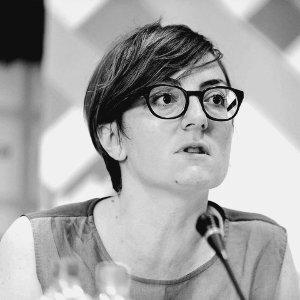
Ana Pejović
Ana Pejović (b. 1980 in Prijepolje, Srbija, then SFR Yugoslavia), She graduated from the Department of English Language and Literature of the Faculty of Philology, University of Belgrade. From 2002 to 2008 she worked at the Rende publishing house as a proofreader, editorial assistant and editor. From 2009 to 2001 she worked at the Belgrade subsidiary of the croatian VBZ publishing house as an editoral assistant and editor. In nine years of work in publishing, she’s edited over two hundred books, mostly local and european contemporary titles, and has spent two years (2011-2013) as co-editor at the Reflektor audio-book publishing house. She translated several books from english, including The British Museum Is Falling Down by David Lodge, and Imagine Me Gone by Adam Haslett. In 2009, along with Vladimir Arsenijević she founded the Krokodil literary association, where she works as a project manager and main coordinator. Translations: Sva mesta na kojima smo živeli, Zdravo druže nedostajao si nam.

Novica Petrović
Novica Petrović was born in Zemun, Serbia, in 1952. He worked at the Faculty of Philology of Belgrade University from 1994 to 2019. Currently teaches translation, British/American literature and cultural studies at Singidunum University (Belgrade) and Sinergija University (Bijeljina, Republic of Srpska). Translations: Champions Die, Too, Don’t They?, Lek za smrt od udara munje, Singularnosti, Beskonačnosti.

Dalibor Plečić
Dalibor Plečić is a writer, literary critic, translator and professor of literature. He has attended several writing residency programs abroad, including Artist in Residence, Q21 in Vienna. He has translated prose, poetry, and plays from Bulgarian, Macedonian and English. He has written a novel (Bunike), a collection of short stories (Zaporožac), as well as published poems in regional magazines. He regularly writes literary reviews for the Booksa portal from Zagreb, The Literary Review magazine from New Jersey and Beton from Belgrade. He is the editor of the culture magazine Zenit from Strumica. Translations: Priče u prošlom vremenu, Između.

Milan Pupezin
Milan Pupezin was born in Kikinda in 1990. Having graduated from the University of Novi Sad with an MA in English Studies, he has been working as a translator, linguist and English, Serbian and Polish teacher. He has published several papers in theoretical linguistics. Milan is both master and servant to three languages: English, Polish and Serbian whereinto he has translated such authors as Lisa Samuels, Bill Direen, Dejan Ajdačić, Mileta Prodanović and Srđan Srdić. He currently works and resides in Poland. Translations: Pelen, Mekana devojka, Javašna Suzan, Kišne ptice.

Ivan Radosavljević
Ivan Radosavljević, born in 1969 in Jagodina. Graduated in Comparative Literature from the Faculty of Philology in Belgrade. Translating (from English, French and Spanish) since 1993. Some of the translations: Andrew Baruch Wachtel, “Making a Nation, Breaking a Nation” (2001), “Remaining Relevant after Communism: The Role of the Writer in Eastern Europe” (2006); Mikel Azurmendi, “Identidad y violencia en suelo vasco” (joint translation with Aleksandra Mančić, 2002); Collin de Plancy, “Dictionnaire Infernal” (2009), Isaiah Berlin; “Russian Thinkers” (2014). Translations: Pogrešan čovek, Zečje ostrvo, Sabrana poezija.